 by
by Ever wondered when you could legally place a bet in India? The answer isn’t a simple date on a calendar. There was no single moment when gambling suddenly became legal across the country. The real story starts way back with the Public Gambling Act of 1867, a British-era law that outlawed most forms of public gambling. Think of it as the original game engine that’s been running the show for over 150 years.
KEY POINTS
A Tangled Web: Unlocking India’s Gambling Laws
For Indian gamers, getting to grips with gambling laws feels like trying to figure out the meta in a brand new, constantly patched RPG. There wasn’t one single “hotfix” that changed everything overnight. Instead, the rules are still heavily influenced by an old, foundational law—the Public Gambling Act of 1867—which continues to be the final boss in many states.
This old-school rulebook made it illegal to run or even be spotted in a public gambling house, specifically targeting games where RNG is the deciding factor. But the story didn’t end there. After India’s independence, the Constitution handed individual states the power to write their own rulebooks. This created the fragmented legal map we see today, where some regions have fully embraced gaming while others have it on the highest difficulty setting. You can dig deeper into this history and the modern legal scene with this comprehensive guide to gambling laws in India.
The Key Difference: Skill vs. Chance
The single most important concept to grasp is the legal distinction between a ‘game of skill’ and a ‘game of chance’. This is the core mechanic that determines why some real-money games get the green light while others are strictly off-limits. Think of it as the difference between a strategy game, where your brainpower and reflexes decide the outcome, and a lottery, which is all about pure luck.
- Games of Skill: These are games where your expertise, strategy, and knowledge are the main stats for success. Think of mastering your hero’s abilities in a MOBA or building a winning deck in Rummy.
- Games of Chance: In these games, the outcome is almost entirely random. This is like spinning a slot machine or betting on a dice roll—no amount of practice can really change the RNG.
This legal distinction is precisely why games like Rummy and fantasy sports have been legally classified as skill-based and are permitted in many parts of India, while activities like roulette remain restricted to specific legal zones like Goa and Sikkim.
Understanding the ‘skill vs. chance’ dynamic is the cheat code to navigating India’s complex gambling laws. It’s why there’s no straightforward “yes” or “no” answer, but one that depends entirely on what you’re playing and, crucially, where you are playing it.
To help you get a clearer picture, here’s a quick summary of the key legal milestones and what they mean for you as a player.
India’s Gambling Laws At a Glance
| Milestone / Concept | What It Means for Gamers | Current Status |
|---|---|---|
| Public Gambling Act, 1867 | The OG law banning most public games of chance. | Still active at a federal level and in many states that haven’t passed their own laws. |
| State-Level Powers | States can create their own gambling and betting laws, like different game servers with unique rule sets. | Leads to a patchwork of different rules. Goa, Sikkim, and Daman are key exceptions with legal casinos. |
| “Game of Skill” Exception | The 1867 Act does not apply to games of pure skill. This is the main quest objective for many gaming companies. | This is the legal basis for the popularity of fantasy sports and Rummy in many states. |
| Supreme Court Rulings | Landmark court cases have upheld the skill vs. chance distinction, basically setting the meta. | These rulings have solidified the legal status of games like Rummy, protecting them from being nerfed as “gambling.” |
| Online Gambling | A legal grey area, as the 1867 Act doesn’t mention the internet. A true Wild West scenario. | Largely unregulated at the federal level, but some states like Tamil Nadu and Andhra Pradesh have banned it. |
This table shows just how layered the situation is. It’s not a single rulebook but a collection of old laws, modern state-level decisions, and crucial court interpretations that shape what’s allowed. As we continue, we’ll break down each of these areas to give you a complete map of India’s gaming world.
The Original Rulebook: The 1867 Public Gambling Act
To get a real grip on India’s gambling laws today, we need to jump in a time machine. Way back before anyone even dreamed of online casinos or esports betting, the British colonial government passed a law that still shapes the entire industry: The Public Gambling Act of 1867. This isn’t just some dusty old document; it’s the core game engine that every other rule and regulation is built on.
Think of it like the original source code for a game that’s been played for over 150 years. Its main quest was straightforward: to outlaw running or even being inside a ‘common gaming house’. In simple terms, it made it illegal to own, manage, or get caught in a public gambling den.
This law was a direct response to the organised betting spots that were popping up and seen as a public menace. It wasn’t really aimed at a few friends having a friendly LAN party at home. The real target was any public place where betting was the main attraction.
What the Act Actually Banned
The 1867 Act was pretty clear about who it was after. It didn’t just throw out a vague “gambling is illegal” statement. Instead, it zeroed in on two key things:
- Operating a Gaming House: The law laid down penalties for anyone who owned or ran a place specifically for people to gather and gamble.
- Being Found in a Gaming House: It wasn’t just the owners who were in trouble. The players themselves could be penalised just for being there.
This focus on the location is a massive piece of the puzzle. The law was much more concerned with shutting down public venues than with what people did in private. That single distinction has shaped how gambling laws have been interpreted ever since.
This timeline gives you a bird’s-eye view of the major legal shifts, kicking off with the foundational 1867 Act. 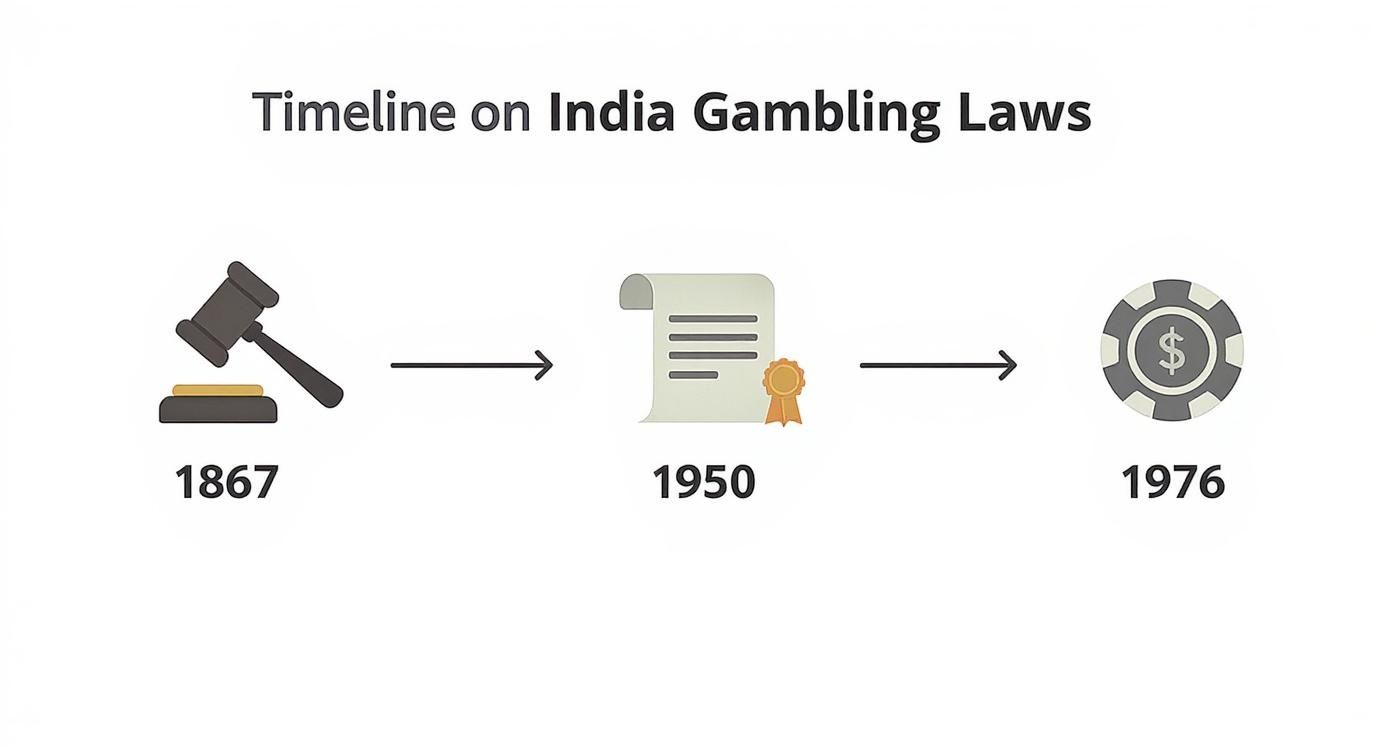 As you can see, the game’s meta stayed pretty much the same for decades. It wasn’t until the Indian Constitution gave states the authority to make their own rules that we started seeing DLC, like the casinos in Goa.
The Private vs. Public Loophole
Now, this is where things get really interesting for today’s players. The way the 1867 Act was written created a huge gap between gambling in a public space versus a private one. Because it was aimed at “common gaming houses,” it left a legal grey area for games played behind closed doors.
A friendly card game for small stakes inside a private home wasn’t the main target. The law’s real focus was on commercial, public operations, creating a loophole that courts have been debating ever since.
This is a critical point. It set a precedent that where you play is just as important as what you play. The law never outright banned two people making a bet in private, as long as the house wasn’t taking a cut (beyond a player’s own winnings).
Of course, the devs of this old-school rulebook never imagined the internet. It was designed for a world of physical dice and cards, not online casinos and servers on the other side of the globe. This is exactly why the Public Gambling Act of 1867 is both the starting point for all Indian gambling law and the source of so much of today’s confusion. It’s the original game that modern updates—like state laws and court rulings—are constantly trying to patch for a completely new era.
Skill vs. Chance: The Ultimate Showdown in Indian Courts
For anyone in India looking to get into real-money gaming, this is the main event. Getting your head around the legal difference between a ‘game of skill’ and a ‘game of chance’ is everything. Think of it like a high-stakes FPS match versus a random loot box drop—one is decided by your ability, the other is pure RNG.
This single distinction is why games like fantasy sports and Rummy are available almost everywhere, while casino classics like roulette or slots are geo-locked to just a few states. For decades, Indian courts have been the referees in this ongoing battle, and their decisions have shaped the entire gaming world for players like us.
The question the courts always ask is pretty straightforward: does a player’s knowledge, strategy, and experience primarily decide the winner, or is it all down to a lucky roll of the dice? If skill is the main stat, the game usually gets a green light. If it’s mostly chance, it’s branded as gambling.
The Landmark Rulings That Wrote the Rulebook
This whole skill vs. chance idea wasn’t just invented yesterday. It was forged in a few epic court battles that still set the rules for the industry today. Two cases, in particular, are legendary for defining the playing field.
First up was the 1957 case, State of Bombay v. R.M.D. Chamarbaugwala. Here, the Supreme Court made a huge call: competitions where success was heavily based on skill were not gambling. This was a game-changer, establishing the legal foundation that skill-based gaming could be a legitimate business activity.
Fast forward to 1968 and the case of State of Andhra Pradesh v. K. Satyanarayana. This time, Rummy was in the spotlight. The court dug into how the game is played and concluded that even though the cards you’re dealt involve luck, winning consistently demands serious skill, memory, and sharp thinking.
The Supreme Court declared that Rummy was predominantly a game of skill. This is the landmark judgment that allows online Rummy platforms to operate legally across most of India today. It’s the legal shield protecting it from the old anti-gambling laws.
These rulings drew a clear line in the sand, backed by the highest court in the country. They created a simple test: if superior knowledge and strategy are what mainly determine the outcome, it’s a game of skill.
Putting It All into Practice: Game Examples
So, how does all this legal talk affect the games you actually want to play? Let’s break down a few popular ones to see where they fall on the skill-to-RNG spectrum.
- Poker & Rummy (Often Considered Skill): Just like the court decided with Rummy, Poker is usually seen in the same light. Winning isn’t just about getting lucky with your hand. It’s about reading your opponents, managing your chips, knowing when to bluff, and when to fold. A seasoned pro will almost always beat a noob over the long run, proving skill is the dominant factor.
- Fantasy Sports (Legally a Game of Skill): This is the clearest modern-day example. Putting together a winning fantasy cricket team takes real knowledge of player stats, pitch conditions, and form. The courts have consistently agreed that this is a skill-based activity, which is exactly why platforms like Dream11 have become so massive.
- Teen Patti & Slots (Often Considered Chance): On the flip side, you have games like Teen Patti. Sure, there’s a sliver of strategy, but the result is almost entirely down to the cards you’re dealt. Slot machines are even simpler—it’s pure Random Number Generation (RNG). You have zero influence on the outcome, making them the textbook definition of a game of chance.
Understanding this legal fight is vital. It’s not just boring legal jargon; it’s the reason you can build a fantasy team from your home in Mumbai but have to fly to Goa to play a hand of blackjack in a casino.
Unlocked Zones: Legal Gambling in Goa, Sikkim, and Daman
While the main story of Indian gambling law is tied to the ancient Public Gambling Act of 1867, a few regions have decided to write their own rules. Think of them as special DLC zones where the restrictions that apply elsewhere just don’t exist. If you’ve ever asked, “when did gambling become legal in India in a real, tangible way?”, these are the places you need to look at.
These states and territories have used their constitutional powers to carve out exceptions, allowing casinos and other forms of betting that are off-limits almost everywhere else. For players, this means there are actual, physical locations where you can legally and safely play games of chance. Let’s take a tour of these unlocked areas to see what makes each one a unique gaming destination.
Goa: The Original Casino Hub
Goa is the OG when it comes to legal casinos in India. It was the first state to shake up its laws, essentially creating the blueprint for legalised gambling that others would follow. Back in 1976, the government passed the Goa, Daman and Diu Public Gambling Act, giving itself the authority to greenlight specific games in designated areas.
This move was a total game-changer. It paved the way for licensed casinos, but with a unique twist that defines Goa’s gaming scene today—the magnificent floating casinos. These are massive ships, usually anchored in the Mandovi River, packed with slot machines, poker tables, and roulette wheels.
- Floating Casinos: Iconic vessels like the Deltin Royale and Casino Pride are the main attractions, offering a full-blown Vegas-style experience right on the water.
- Land-Based Casinos: While the floating casinos get all the attention, Goa also permits electronic slot machines in some five-star hotels on land.
Goa’s decision to legalise casinos was driven by a smart plan to boost tourism, and it worked spectacularly. Today, it stands as India’s most famous and glamorous gambling destination—an absolute must-visit for any serious player.
Sikkim: A Pioneer in Modern Gaming
If Goa wrote the first chapter on legal gambling, Sikkim is busy writing the next one. This Himalayan state has taken a much more forward-thinking approach, embracing both traditional casinos and the new digital frontier. Sikkim went live with its own law, the Sikkim Regulation of Gambling (Amendment) Act 2005, which set the stage for land-based casinos.
The state is home to premier casinos like Casino Mahjong and Casino Deltin Denzong, both located within luxury hotels. But what really makes Sikkim a pioneer is its bold approach to the online world. It was one of the first states to not just allow, but to actively regulate and license online gambling and sports betting.
While other states were still arguing over the 1867 Act, Sikkim was already building a framework for the digital age. This makes it a critical place to watch for anyone interested in the future of regulated online gaming in India.
The Sikkim Online Gaming (Regulation) Act, 2008 was a truly groundbreaking piece of legislation. It created a system for issuing licenses to online gaming operators, making Sikkim the first—and for a long time, the only—state with a clear legal structure for online betting.
Daman: The Quiet Contender
The union territory of Daman is another unlocked zone on India’s gambling map. Following Goa’s lead, it enacted the Daman and Diu Public Gambling Act of 1976, which allows the government to permit casinos within its borders.
While it might not have the high-profile reputation of Goa, Daman is home to The Deltin, a massive integrated resort with one of the country’s largest casinos. This makes it a significant, if quieter, player in the legal gambling scene. The rules here are similar to Goa, with operations restricted to top-tier hotels to ensure they cater primarily to tourists.
Together, these three regions—Goa, Sikkim, and Daman—represent the current frontiers of legal casino gambling in India. They are the only places where the central prohibitions of the 1867 Act have been officially overridden by local laws, creating safe and regulated environments for players. For anyone seeking a legal and authentic casino experience, these are your go-to destinations.
Welcome to the Wild West of Indian gambling law—a place where old rules just don’t fit the modern game. The core law, the Public Gambling Act of 1867, was drafted a full century before anyone even dreamed of the internet. This has created a massive legal grey area for online casinos, betting sites, and crypto-gaming.

The big question on every player’s mind is simple: is online gambling legal in India? Frustratingly, the answer isn’t a straight yes or no. The key thing to understand is that no single central law explicitly bans an individual from playing on an international online casino. This is the very loophole the entire offshore gaming industry is built on.
These international platforms operate from places like Malta or Curaçao, putting them outside the direct reach of Indian law. They happily accept Indian players and offer familiar payment methods like UPI and local e-wallets, which makes playing feel completely normal. Legally, though, you’re playing in a zone that Indian regulations don’t directly control.
The Offshore Casino Loophole
So, how do these sites get away with it? It all comes back to that dusty old 1867 Act, which was designed to shut down physical “common gaming houses” within India. An online casino hosted on a server in another country doesn’t physically exist in India, allowing it to neatly sidestep this law.
This setup creates a unique situation for Indian players:
- No Central Ban: From a federal standpoint, there is no law that stops you, as an individual, from placing a bet on an offshore website from the privacy of your home.
- State-Level Rules: This is where it gets tricky. Some states, like Tamil Nadu and Andhra Pradesh, have taken matters into their own hands, passing specific laws to ban all forms of online real-money gaming. So, where you live can completely change the rules.
The core issue is that technology has sprinted miles ahead of legislation. While the central government hasn’t written a new rulebook for the internet age, some states are patching the game themselves. This has created a fragmented and often confusing map of what’s allowed and what isn’t. Always, always check your local state laws.
This constant push and pull between old federal laws and new state-level bans creates a very uncertain environment. To give you a clearer picture, here’s a quick look at how different states are handling the online gaming scene.
State-by-State Online Gaming Status
The legal status of online gaming can feel like a patchwork quilt, with each state sewing its own rules. Some have embraced it with regulation, others have banned it outright, and many remain in a legal grey area. This table breaks down the current situation in key regions.
| State | Legal Status | Key Legislation or Reason |
|---|---|---|
| Sikkim & Nagaland | Regulated | These trailblazing states have their own laws to license and regulate online games of skill. |
| Goa & Daman | Permitted (Limited) | Primarily focused on land-based casinos, but their legal framework allows for some online expansion. |
| Tamil Nadu & Andhra Pradesh | Banned | Have passed specific state-level legislation to prohibit all forms of online real-money gaming. |
| Most Other States | Grey Area | Rely on the old 1867 Act, which leaves online gaming unregulated but not explicitly illegal for players. |
Understanding this table is key. Just because an activity is in a “grey area” doesn’t mean it’s risk-free. It simply means the state hasn’t passed a specific modern law to address it, leaving players to navigate the ambiguity of the old federal act.
New Rules, New Chaos: The GST Shake-Up
Just when players were getting used to the grey area, the Indian government threw in a major plot twist. In 2023, a uniform 28% Goods and Services Tax (GST) was imposed on the full face value of all real-money online gaming transactions. This wasn’t a small tweak; it was a financial earthquake for the entire industry.
In simple terms, if you deposit ₹1,000 to play, the platform now has to pay ₹280 in tax right off the bat, leaving you with less to actually play with. This move has been hugely controversial. Many gaming companies argue it cripples their business model and, more importantly for players, pushes them toward illegal offshore sites that don’t comply with any Indian laws.
Using cryptocurrencies for gambling adds yet another layer of complexity. While crypto itself isn’t illegal in India, the Reserve Bank of India (RBI) has repeatedly warned about its volatility and risks. Using it for gambling puts you in an even murkier legal and financial position, with practically no protection if things go wrong.
Common Questions About Indian Gambling Laws
Even after that deep dive into the legal maze, you probably still have a few questions buzzing around. That’s perfectly normal. Let’s tackle some of the most common queries Indian players have in a quick FAQ session.
Is It Illegal for Me to Gamble Online in India?
This is the big one, and the answer is a classic “it depends.” No central law makes it a crime for an individual to play on an offshore online casino. The ancient laws, like the Public Gambling Act of 1867, were written to shut down physical gambling dens, not to chase down someone playing on their phone at home.
But here’s the catch: individual states have the power to make their own rules. States like Tamil Nadu and Andhra Pradesh have passed their own laws that specifically outlaw all forms of online real-money gaming. So, the real answer depends entirely on your server region (i.e., where you live). Always, always check your local state laws before you even think about placing a bet.
Are My Winnings from Gambling Taxable?
Yes, absolutely. The taxman is the final boss. Any money you win from lotteries, card games, betting, or anything else considered gambling is hit with a flat 30% tax under Section 115BB of the Income Tax Act.
This isn’t something you can choose to declare later; it’s a direct tax. If your winnings exceed ₹10,000, the operator is required to deduct the tax at source (TDS) before you even get the money. It doesn’t matter if the game was legal or not—if you win, you owe tax.
Why Are Fantasy Sports Like Dream11 Allowed?
This question goes straight to the heart of the great Indian gambling debate: the battle of ‘skill vs. chance’. The courts have consistently found that fantasy sports are primarily games of skill. To win, you need to use your knowledge of sports, analyse player stats, and build a strategic team.
Since your skill is the deciding factor—not just blind luck—it doesn’t legally count as ‘gambling’ under that old 1867 Act. On the other hand, betting on a coin toss or the simple outcome of a match is seen as pure chance, which is why it remains illegal in most of the country.
How Do I Choose a Safe and Compliant Online Platform?
Playing online requires a bit of homework to make sure you don’t get scammed. Think of it like checking a game’s reviews on Steam before you buy it.
Start by looking for platforms with proper international licences from respected regulators like the Malta Gaming Authority (MGA) or the UK Gambling Commission. Then, make sure they use secure, well-known payment methods and offer responsible gaming tools like deposit limits or self-exclusion options.
Finally, do a quick search for recent, honest player reviews on trusted sites like TheGambling. This will give you the real story on a casino’s reliability and how quickly they pay out winnings. A few minutes of research can save you a world of trouble.

